Showing posts with label 100 mile run training. Show all posts

Monday, 16 April 2018

Ultra training plans #10 Pacing for ultras

#10 The final topic! PACING
You can do everything right in your training, fuel properly, plan the race out, get the kit you need and then screw it all up by racing off too fast at the start trying to keep up with others (who are possibly going too fast also)
It's a painful way to run.... Exhaust yourself early on then struggle it in for the second half. Grim. We've all done it. Us blokes tend to be worse... Ladies are sometimes guilty too though.
In my eyes the ideal pacing is that where you are just beginning to fade at the end but can just about hold it together. IF you do a massive 'negative split' eg run the second half loads faster than the first, you probably weren't running hard enough initially. If you get to halfway or 80% through then crash and burn, enjoy the rest 


A couple of examples.... first from myself.... I ran 47 miles in 6 hours 6 mins back in 2012 on a trail. The 10km was 42 mins pretty much dead on.... My final 10km was about 55 mins
My eventual average was 7 min 51 mile.
I was psyched up and flying early on it felt easy, relatively comfortable for 4 hours but... Battling a bit of a head wind and just generally running a bit too hard the final 2 hours was very tough. Looking back I probably needed more fuel too and should have had a more detailed look at the route towards the end.
I can think of plenty of examples of others too, I don't like to use positions as a measure of a good performance because you just don't know who is going to turn up, if you go and 'win' an LDWA event it might not be as good of a performance as coming 30th in a competitive race.
In a 40 mile race I did a couple of years ago, the 2nd place runner was sticking with me up until about 18 miles then in the final 22 miles lost over 1 hour on me and barely hung on to 2nd position. You have to run your own race. There's an element of mental games and psyching out opponents in the later stages or in shorter races but when we're talking longer races especially ultras.
Let's suppose we're battling for the 1st and 2nd positions in a race, we're neck and neck for the first half of the race but you are pushing at an unsustainable pace, where as I am just keeping it steady and matching your pace, when we get to the final climb and a few miles to go, I've not been working as hard and can therefore push the pace and keep the intensity whereas you've burnt out and just can't answer to the injection of pace at the end.
Play to your strengths by all means, just to start with, be sensible with your pacing, your overall time will be better and usually that means your position will be higher too! After you've won a few races it might not feel the same, but that feeling you get when you run your hardest and achieve more than you ever thought possible.... That never gets old 
Hope you have loved the last 10 articles! Stay tuned for a bonus one tomorrow

Happy trail slaying folks 

Ultra Running training plans #9 Speed training for ultras

#9 Speed Training for Ultras
Following on from earlier in the series of articles we talked about specificity and training planning along with mileage. Let's jump straight to it....
Initially, your ultra running performance will probably NOT be limited by your speed, you'll be busy making mistakes with nutrition and getting lost along with having a picnic at each checkpoint like I did. There are a couple of factors that come in to play, your running economy, your conditioning, your stamina, mental toughness etc.
Once you've built a bit of experience making some mistakes and practicing different strategies (or learned from someone else's mistakes) you'll be able to keep your body fueled and you'll be finishing some ultras mid pack perhaps in the top half. You'll eventually hit a plateau from just running more. To really make a difference in your ultra running times let's consider this
What are the chances of running at your 10k pb pace for a 30 mile ultra? Much less 50 mile or 100! Exactly....Nobody in an ultra race is 'sprinting' EVEN the 'fast ones'. Every runner is running this at a relatively low intensity compared to their 10k pb pace.
So you do get some variances, some people can maintain a higher % of their maximum effort or heart rate for longer than others but, if someone can run flat out for 10k and it takes them 60 mins they are going to be going a lot slower than this when they run 30 miles.
If this runner improves their speed though, so that they can run 10k now in 50 mins instead of 1 hour then slowing down to run a 60 min 10km pace (or 10 min mile roughly) is going to be much more comfortable and therefore be able to go much further at this pace.
When I started running I couldn't run 10k but I built up to it and then eventually I managed to run quicker than 1 hour. So that was a 10 min mile pace.... Now I can run 10km at about 5.30 min mile pace sooooooo..... Slowing down to 7 minute miles for me feels fairly comfortable. With a proper training plan I'm now able to run under 7 min miles for 50 miles. If I never improved my speed much from starting running this would be impossible as I couldn't even run 1 mile this quick when I first started.
A post shared by Charlie Sharpe (@charliethatruns) on


If we take someone who can run a 30 min 10k which is about 5 minute mile.... a 6 minute mile is going to feel fairly comfortable, a 10 minute mile is going to feel like an uncomfortable shuffle.
Bottom line, speed is still a factor in ultra running and shouldn't be neglected, it might not be a prime focus year round every single week but it should certainly feature during some of your training phases.

Wednesday, 6 September 2017

100 mile ultra run training #4 Kit

100 mile ultra training #4 kit

You can checkout my kit on the 'My Kit' Tab


#4 Kit!
Kit should be straight forwards... However, often the focus for kit is in the wrong direction... Rather than thinking can I get a jacket that's 50g lighter, should we instead be asking, 'Is this going to keep me warm and dry if I get stuck on a mountain?'
When you're out racing for a long time like in a 100 mile ultra, maybe even just a hilly trail marathon, you might experience some poor weather conditions. If your jacket is leaking and you've not slept all night and it's getting cold and your legs are tired but you've got all your kit on, it's very easy to get to a nice warm checkpoint and think 'Bugger it, I'm not going back out in that' as you begin to shiver at the thought of heading back into the cold night.

In reality you aren't injured or anything and physically could keep going but just the discomfort of plodding on in those conditions isn't a nice thought. You end up with a DNF because you took a poor quality jacket and skimped on kit. Perhaps the next people into the checkpoint are at least dry on the inside and heading back out into the rain they are at least shielded from the rain. An hour later the weather could brighten up and clear, maybe it will get worse, either way just having the right kit for the job can keep you in a race! It doesn't mean you need the most expensive fancy things, just something that is 'fit for purpose'

The other big point about kit is make sure you have practiced and are used to the kit you are going to use, don't turn up in new kit on the start line that you've never used. Eg I've met someone totally lost with a GPS in hand because they didn't know how to use it, I've seen some impressive cuts from a poorly fitting backpack grating at the skin all day and more posts online about foot problems than I could ever count.

After a while you should be able to dial down your kit and know exactly what you need so you can confidently turn up to the race knowing that you can handle what you're going to face without any panic or worry that everyone else is carrying something different to you.

See you on #5 for the next thing that'll go wrong on you one day, fuelling and nutrition for 100 mile ultras

100 mile ultra training #3 race plan

#3 PLANNING
We've ticked off some of the basics already, next we need to think about the actual race plan. Now some people turn up and have no idea what they're in for and yes, do get to the end. My best performances and those of my clients have come from having a race plan. It might be as simple as just knowing a few basic things like the number of climbs in a race or which parts of the course you expect to do during the night.


I like a balance between simplicity and detail although it depends a little on the route... For flat races or routes that are lapped perhaps, this is easier as the terrain is consistent... For mountainous races which I like, you might have a couple of hills in the first half then 10 giant climbs during the second, either way good to know this and plan accordingly.

So you should have an idea of what sort of pace you can move from your training and warm up events. Eg my 3rd 100 mile race with about 4500-5000m ascent I had done a 56 mile race with about 2500m ascent and a 40 mile with 2000m at an intensity that was comfortable for me. I figured if I could do 56 mile in 12 hours relatively comfortable and with some navigational errors probably costing me 30 mins total I'd be able to finish the 100 mile about 24 hours all going well (In reality I did 18 hour 23 as I'd underestimated my fitness and pace and over estimated the course!!)

Knowing approximately what to expect time wise, even a ball park, helps you decide on the kit choices (step #4) and fuelling strategies (#5) You might love detail and do everything down to the minute, You might decide that the 2nd half of your 100 mile is going to be about 2 hours slower than the first half, then when you get halfway you know what you're facing.Not having a plan is like setting off driving somewhere when you have no idea of the destination and can lead to complete confusion or overwhelm.

Sure you might hit a bump in the road and have to adjust your plan as you go but at least you can prepare mentally for this.If you are planning a 20 hour finish time and you hit half way in 12 hours, you can realise that you're 2 hours off the plan and decide an appropriate adjustment... Maybe you just massively under estimated the route and potentially could be out for 4 hours longer than you expected, now you can start fuelling additionally to cover it or pickup extra kit from your drop bag because of the cold night you're about to be running in unexpectedly...

Tuesday, 5 September 2017

100 mile ultra lessons and advice #1

You've heard it before 'It's all in your head' and 'Mind over matter' well here's my number 1 lesson from this pile of 100 mile + medals (except for the Trans Grancanaria one actually that's only 80 mile)

MINDSET
I'm not going to take you on a magically journey of self discovery but stick with me a moment.
So my first 100 mile was going to be the Conti Thunder Run in 2011 but for some reason about 6 weeks before I decided to enter the UR 100 mile at the last minute in June.
Now I'd done a couple of back to back marathons a 50k then a 50 mile and a 12 hour race but then I got run over whilst cycling!!

I wasn't able to run without pain and I was told to do nothing for 6 weeks (which I interpreted to mean go out on the bike instead, I couldn't stand up and peddle but sat down and in easy gears I could roll along) I did a couple of easy runs after about a month then entered the 100 mile with the plan to basically walk with some odd bits of running slowly. Set out right at the back and pretty much was the back runner until the later stages, everyone I overtook was dropping out.

It wasn't exactly plain sailing... I had made no plan for the race at all and had no idea of the route or what was really involved, I lost my jacket and head torch somehow so literally did the whole night in the dark with no light, and it rained for most of the night, I had a spare poncho and just toughed it out.

About the only good news was that I made it to the finish and didn't have any injury issues apart from a dead mobile phone from all the rain. Anyhow..... What got me through this whilst everything around me went wrong was my mindset. I was determined to keep moving and therefore I would eventually reach the finish. How hard could it be?

Nowadays I am much stronger mentally but I also have solid race plans and good knowledge of my ability. The mind is focused on how hard to push myself when it gets tough.

I've put mindset first because no matter how fit you are, or how much fancy equipment you've got.... If your mind isn't in it your body can shut down and give up in no time


Tuesday, 22 August 2017

Persenk 160km Ultra Marathon, Bulgaria


Jump on the YouTube video below where I take you through the Persenk 160km 2017 in Bulgaria
A great 100 mile ultra marathon. Some tips for 100 mile running and general ultra running tips throughout. Quite tough if it was your first 100 mile ultra but ideal if you want to run a 100 mile mountain race with just over 7000m ascent. 


https://youtu.be/rBKGuVGs6j0

Wednesday, 13 April 2016

Northburn 100 mile New Zealand 2016

Back in 2008 I spent almost 2 years in New Zealand, ever since I left I always wanted to go back. I was mainly bouldering then, did some hiking too but wasn't really a runner. I decided that to make it a worthy trip I'd pack in a few races and base myself out in the mountains of Wanaka to train.
The Northburn 100 mile has been running for a few years now and has grown it's reputation for being wild and tough, the hills are very exposed, tracks are generally a bit rough underfoot with some off piste tussocky, spear grass lined patches here and there. In terms of the route it's just a slither over 100 mile with around 10000m of ascent... Some people were claiming 11 but I clocked on just under 10 including my little diversion. Weather-wise we got dry conditions with some strong winds on the top, (i got blown over a fence and had to crawl at one point) it was pretty hot down in the valley. Had it been less windy it would have been hotter... That would probably have caused more issues than the wind.


Kit check and registration was Friday evening then a very entertaining briefing from Terry, one of the organisers... We got a good and detailed run through of the course along with advice like
'The entire area is a big mass of hazards for you runners'
'Beware of the foliage'
The course had grown a bit since previous editions apparently an extra 1000m of climbing had been squeezed in. To give an idea of difficulty  there is a 48 hour cut off.
Come Saturday morning 6 am start we lined up along with 50km and 100km runners and set out into the dark. There is an initial flat 5km loop before heading off on the first long gradual climb to 1600m at about 25km. I'd ended up with the lead 50km runner until about 15km in where I moved ahead as we reached rougher ground. I hadn't expected to be leading ahead of the shorter races too but was happy with my effort levels and took it as a good sign. It was cloudy up high at this point so I just kept paying attention to the markings and passed through a checkpoint before starting to descend. It all went fairly smoothly I cruised down, kept sipping through water and grazed off a bag of jelly snakes and reached another CP where the marshal informed me I was starting the 'loop of despair'....
I jogged on up the climb and saw the leading 50km runner about 5-10 mins behind though nobody else as far as I could see. The course weaved around a gully and I followed the tape to a good track which started to descend. The previous checkpoint came back into view and I thought great! The path met the previous track I'd run up earlier and I carried on down to the checkpoint where the marshal informed me I shouldn't be here again!!! I'd been confidently following markers the whole time and couldn't figure what had happened. After a minute or two trying to figure out what happened I saw the map in the car that the checkpoints each had. I took a look and set off to retrace my steps back up the hill.


I'd done just shy of 3km extra and about 20 mins when I saw a guy I'd meet a few weeks earlier heading towards me past a marker. I stopped him and we scanned around to see some markers over the fence in the next paddock. I ripped a couple of the markers and tied on extra so it was more obvious. 2 runners had gone the correct way off the 50km and me and Paul had gone wrong, at this point nobody else has reached the turn. From this point I was stopping at nearly every bend and twist to look for markers and had a really stressful next few km. I then saw a lady running who wasn't in either of the ultras but was in the half marathon and that confused me even more... After stopping and starting, I decided just to carry on to the end of the loop and see if I was on course or not and decide what to do from there. Luckily turns out I was on track though two 50km runners had finished before me. (Well done Lucy and Paul)


I'd planned to throw down a tin of rice pudding here in an attempt to eat more than I usually do. I had about a third of a tin but decided that wasn't going down well and headed out on the second loop. I was trying to regain my focus after losing around 30 mins on loop one I was concerned about the markings and really hesitant at junctions. The course layout is pretty confusing with various loops crossing and weaving all over. The maps that cp staff had were good, would have been no problems at all if runners were given those to. I didn't take any wrong turns for the rest of the race but being in the lead meant I was the first at checkpoints and together with some of the marshals we had to figure out where I was actually meant to go next, had i not double checked with a particular checkpoint on loop 3 I would have just been sent the wrong way. They called to HQ to check where to send me as I was certain I should be climbing more.


Anyways... I was out on the second 50km loop (different to the first) and was still on track for what I thought would be a sub 24 hour time. I reckoned if I did the first 100km in 12 hours I would have 12 hours to do the last 60 odd km loop which would be fairly easy. Moving up the next climb back to 1600m I felt like I was crawling, I regretted the rice pudding and decided from there I'd stick to liquid calories like usual. I lay down in a stream for a few minutes to cool off and it was like hitting the reset button. I finished the rest of the climb and here came the windy ridge... It was here I got blown over a fence then a little later had to crawl on my hands and knees along a section of the ridge as I just couldn't move into the wind. I've been blown off my feet a few times by strong gusts but this was sustained strong wind. I was feeling good and treated to some awesome views of leaning rock. There was a van checkpoint here and the guy inside couldn't get the door open against the wind. I confirmed the direction and headed downhill one more.


I felt really strong over the next few km and the second 25km of the loop just breezed past, it wasn't long before I was heading back in to the main aid station and finishing loop 2. The watch was showing 107km in 12.44, considering my early detour I was happy with that and topped up my water and got more batteries etc for the night that was to close in shortly.
Another long climb here about 12km gaining 1200m. I knew there were 3 more decent climbs on the loop but didn't really pay any attention to the time from now. I was visiting the same checkpoints as the previous loop but a totally different order. As I was now crossing paths regularly with people still on the previous loop I spent a lot of time trying to check I was going the right way. The last thing I would have wanted was to go off course. The terrain was pretty similar aside from a little descent to a water race where a few safety ropes had been rigged up to stop anyone jumping off the edge. Soon enough I'd hit the little mountain hut checkpoint TW for the final time after the two climbs and was just 20km from the finish including a final climb. I'd had word that I was miles clear of 2nd and so enjoyed cruising down the long descent to a final cp. Just one more hill! Everything felt great and from the top it was obviously all downhill to the finish and I was passing many runners coming the other way who were just starting out on their last 60km loop. I shouted a few 'well dones' but tried not to give away that I was about to finish.
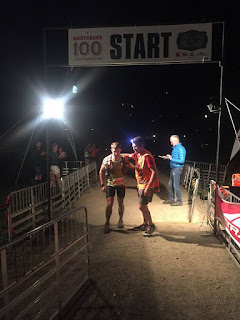


I rolled in just after 4am finishing in 22 hours 11 mins. I'd like to say a huge thank you and well done to those involved both organising, competing and supporting! Together it all added up to a great event!


I've not counted recently but it's getting toward 20x 100 mile or longer races that I've done, all my highest placing and generally best runs have been on majority liquid calories and minimal solids. Bottom line for the longer races you need to be putting calories in one way or another, I hear of a lot of people struggling to fuel properly which can lead to some epic drops in pace. When I was doing my first couple of years of ultras I ate a lot more solid food I guess as I was less fit my stomach could keep up with digesting stuff whereas now I can keep a much higher average pace it seems easier to stick to liquid.
Heading back to Europe soon, my next trail run coaching week is in June (details on my website) and I've a few races lined up before then leading up to Andorra Ultra Trail in July (170km with 13500m ascent)
Should be interesting!